No rain from May to September, the same water for every bed… And three very different stories underground.
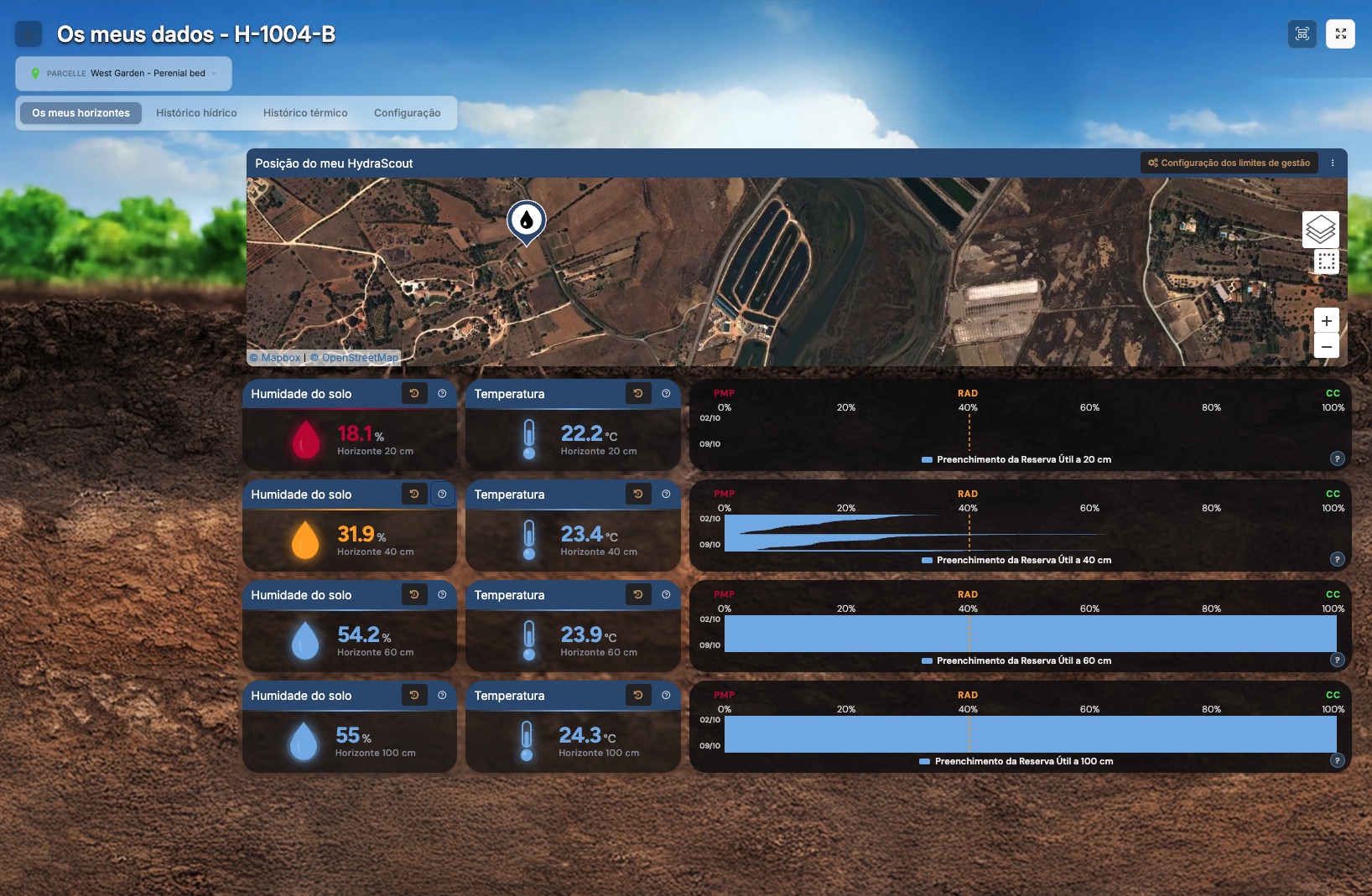
Back in April, Mud Valley Foundation and Quinta Vale da Lama installed three soil moisture probes in the farm’s market garden, as part of the EU-funded MORFeuS program. Each probe reads soil moisture and temperature at four depths (20 cm, 40 cm, 60 cm and 1 m) around the clock.
From May to September it didn’t rain at all. Every drop those beds received came from our irrigation system, and each bed got the same amount. That makes this first summer a rather good natural experiment: same water, same sun, three different soils. Here’s what happened to the water.
Three beds, three stories
The hügelkultur bed (West Garden, perennials). Here the water went down, and stayed down. After each watering, the sensors at 40 cm and 60 cm responded within a day or so, and over the summer the 60 cm layer actually got wetter, rising by about a third, in a season with no rain. The buried wood at the heart of the mound seems to be doing what we hoped: soaking up water and holding it where roots can reach it. The surface, meanwhile, was the driest of the three beds, as water drained quickly into the mound below.
The alley-cropped annual bed (West Garden). This bed told a story of calm. From 40 cm down, moisture barely moved all summer: the readings at 40 cm and 60 cm were almost flat lines from May to September, and the 1 m sensor ended the season where it began. All the action was in the top 20 cm, where the annual crops were drinking, and which lost about a third of its moisture. Underneath, a steady reserve sat largely untouched.
The East Garden (our control, with few soil interventions and no trees). This bed had a hard start. It flooded badly earlier in the year, with standing water for weeks. Through the summer its middle layers, 40 cm and 60 cm, lost around half their moisture, partly drying out after the flood and partly because irrigation barely reached them: the water stayed near the surface. Only the deepest sensor, at 1 m, held steady.
What we can (and can’t) say yet
This is one season, with one probe per bed, and the flood muddies the comparison with our control. So these are patterns, not proof. But they’re striking ones. The beds where we’ve worked the soil, building in organic matter and carbon, are keeping water in the root zone through a Portuguese summer without rain. The control bed is not.
From the calendar to the ground
Right now, like most farms, we water on a schedule: so many minutes, so many days a week, whatever the soil is actually doing. This summer’s data shows what that costs. In one bed the subsoil stayed comfortably moist all season, while in another, water never got past the surface.
Our aim for the coming seasons is to turn that around: to evolve our irrigation from being schedule-driven to being driven by conditions on the ground. That means watering a bed when its root zone tells us it needs it, at the depth where the plants are drinking, and not before. In a semi-arid region where every litre counts, letting the soil set the schedule may be the most water-wise thing we can do.